About this Blog

Between the Arab Spring, the revolt in Syria and the increasing discussions regarding attacking Iran to prevent them from developing nuclear weapons, the Middle East has never been in a state of greater ferment. This blog aims to bring our readers a flavor of what the issues are. An effort will be made to be as objective as possible, especially in regards to the Iranian crisis, and to let readers draw their own conclusions. Feel free to also visit my other blog at www.attackingiran.blogspot.com.


Saturday, May 26, 2012

Part 4 of Israel, Iran and Hezbollah: Israeli Military Plans to Destroy Hezbollah in Next War


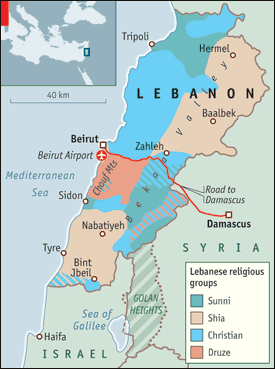
Israel's border with Lebanon - Frontline with Hezbollah
While Hezbollah has 60,000 missiles, the Shiite organization is still no match for the Israeli military.  Israel has recently made clear to Hezbollah that if it attacks Israel, the Israeli military is prepared to destroy Hezbollah and much of Southern Lebanon if necessary.  In a recent article in the UK's Telegraph, Israeli military sources make clear that if Hezbollah attacks Israel in response to an an Israeli strike against Iran's nuclear program, Israel will seek to destroy Hezbollah and southern Lebanon will suffer massive damage in the process.  The headline alone in the Telegraph piece sums up Israel's intentions:
Any Hizbollah retaliation to an attack on Iran's nuclear facilities would prompt Israel to launch a war in Lebanon so ferocious that it would take a decade to rebuild the villages it destroys, a senior Israeli military officer has warned.
 Hezbollah's missiles and military infrastructure in southern Lebanon is closely embedded within Shiite villages in the region.  The Israeli military leadership believes that Hezbollah's embedding of their missiles within civilian structures in 2006 led the IDF to take too cautious an approach against Hezbollah in the 2006 war, and they are determined not to make the same mistake next time:
"In these villages where Hizbollah has infrastructure I will guess that civilians will not have houses to come back to after the war," he said.
Pretty scary stuff I'd say.  The Israelis are sending both a clear message to Hezbollah of the risks of starting another war with Israel, as well as making clear that this time the IDF intends to finish the job.  Here is the entire Telegraph article.
Israeli tanks ready to battle Hezbollah


Friday, May 25, 2012

Part 3 of Israel, Iran and Hezbollah: Hezbollah's Missiles and How Hezbollah Might Attack Israel


Hezbollah's arsenal of missiles for striking Israel

Hezbollah's missile able to hit all of Israel
As I have mentioned, I am looking at the possibility that if Israel attacks Iran's nuclear program, the Iranians will order their Shiite client Hezbollah in Lebanon to strike Israel.  Here is Part I and Part II of this series.  This post will look at Hezbollah's capabilities to hit Israeli targets.

Two weeks ago, Hezbollah leader Hassan Nasrallah stated that Hezbollah now had the capability to strike anywhere in Israel.  According to Reuters, Nasrallah stated in his speech:
"Today we are not only able to hit Tel Aviv as a city but, God willing, we are able to hit specific targets in Tel Aviv and anywhere in occupied Palestine," Sayyed Hassan Nasrallah said in a televised address.
Given that Hezbollah now has 60,000 missiles of all types, it seems more than likely that Nasrallah's claims are correct.  One interesting fact is that Hezbollah is even claiming that it has plans to use ground forces to capture Israeli territory in northern Israel's Gallilee region.  While this is unlikely, it does demonstrate Hezbollah's clear plans to very aggressive in any war with Israel.  The various images in this post take a look at Hezbollah's capabilities.

Hezbollah Plans to capture Israeli territory


Hezbollah's arsenal of rockets - 60,000 missiles ready to strike Israel


Thursday, May 24, 2012

Part 2 of Israel, Iran and Hezbollah: Israel's Possible Response


Lebanese soldiers patrol the border with Israel
Israeli army troops on the border with Lebanon
As I noted in Part I of this mini-series on Hezbollah and Israel, it is quite possible that Iran would order its client Hezbollah in Lebanon to attack Israel if Israel launched an attack against Iran's nuclear facilities.  Looking at the situation, Israel must be aware that if they attack Iran, Iran would strike back directly against Israel, likely via terrorism against Israeli targets worldwide as well as with its own inventory.

The question I raise, however, is how Israel will respond to an attack by Hezbollah against them, particularly if Hezbollah targets Israeli population centers?  From Israel's perspective, as long as they do not attack Hezbollah, they would not expect Hezbollah to attack them.  The answer to how Israel would act if there is another war between the Israelis and Hezbollah comes through loud and clear in a recent article by Con Coughlin in the UK paper Daily Telegraph.  Coughlin notes that while Israel and Hezbollah essentially fought to a draw in their last war in 2006, in the next conflict Israel is determined to wipe out Hezbollah's military capabilities completely:
During the last conflict, Israel was forced to agree to a ceasefire because of the international outcry over its air raids against Lebanese targets, such as Beirut airport. Next time, though, the Israelis are determined not to end the conflict until Hizbollah is completely destroyed as a fighting force...This time, the war is going to last for as long as it takes to destroy Hizbollah,” said an Israeli officer. “We will not make the same mistake of allowing them to escape.”
With Hezbollah possessing 60,000 missiles, as compared to 10,000 in 2006, and with Israel committed to doing whatever it takes to destroy Hezbollah, it is clear that the next conflict between the two will be brutal and bloody.  Here is the Con Coughlin article

Wednesday, May 23, 2012

Part 1 of Israel, Iran and Hezbollah: If Israel Bombs Iran Will Hezbollah Attack Israel?


Hassan Nasrallah is the leader of Shiite militia Hezbollah
As I noted in a post from a few days ago, the signs out of Israel are mixed to say the least, with the Israeli leadership "locked down" regarding a possible Israeli attack on Iran.  It occurred to me that while there are numerous news reports on how Israeli might attack Iran, there is not nearly the same amount of information available on how Iran might retaliate.

One thing which is highly probable though is that Iran would order its client Hezbollah in Lebanon to launch an attack on Israel if Israel bombs Iran's nuclear stations.  I am planning to do a five part series on the possible issues and concerns regarding an Israeli-Hezbollah war.  While Hezbollah is nominally independent of Iran, in reality Iran provides all of the funding and support necessary for Hezbollah and it is highly likely Hezbollah leader Hassan Nasrallah would launch Hezbollah's missiles at Israel if ordered to do so by the Iranian leadership.  Iran is the leading Shiite state in the region, and Hezbollah is a Shiite militia group in Lebanon.  As those interested in the region might recall, Israel and Hezbollah fought a short but destructive war in 2006, during which Israel heavily bombed Hezbollah's positions in South Lebanon while Hezbollah launched streams of short-range missiles at Israeli population centers.

Just today, there was a worrying report in the left of center Israeli newspaper Haaretz noting that the Israeli military (IDF) now believes that Hezbollah has over 60,000 missiles, or six times what they had in the 2006 war.  The article also notes that both Syria also has 3,000 missiles covering anywhere from 70 - 700 kms. Needless to say, the chance of a miscalculation that might set the Middle East aflame is unfortunately quite high. For those interested in the full Haaretz article on Hezbollah's missiles, here it is

Monday, May 21, 2012

Excellent Article on Sunni-Shia Conflict from the Economist


Sunnis versus Shia in the Middle East
In writing this blog, I have had as one of main themes that the conflict between Sunnis and Shia is one of the primary causes for strife in the Middle East.  For review of the Sunni-Shiite split, feel free to review this previous post; I also have noted the influence of the Sunni-Shia conflict in Syria, as well the ongoing struggle in Bahrain between the minority Sunni leadership and the majority Shiite population of Bahrain.

Continuing this analysis, the Economist recently published an article that explicitly discussed the issue of Sunnis versus Shiites in the region, and noted the right now the Sunnis appear to be ascendant after several years where it looked like the Shiites were driving events in the region.  The article notes:
These days zealous Sunnis need no longer look to swashbuckling Shias for inspiration. The real action is unfolding in their own homelands, at least in north Africa or the Levant. Nor need they look abroad for political ideology: the Arab spring has established the Sunni sort of political Islam as a powerful, domestically based force that has emerged from the underground or from exile.
For those interested, here is the full Economist article on the current status of Sunni-Shia relationships in the Middle East.


Friday, May 18, 2012

Israel Ready To Attack Iran? "Israeli Elite Locks Down" - Reuters


Fordow Nuclear Facility - Note Tunnel Entrances Underground
The Reuters news service came out with a very interesting article noting that top of Israeli officials have recently refrained from public warnings or threats about a possible Israeli attack on Iran.  Whereas the top Israeli leadership used to frequently note that an Iranian nuclear capability would be unacceptable, lately the talk about a possible Israeli attack on Iran has been toned down significantly.  The Reuters article notes the silence by Israeli leadership on this issue:
"The top of the government has gone into lockdown," one official said. "Nobody is saying anything publicly. That in itself tells you a lot about where things stand."
The Israelis are of the opinion that once the key components of the nuclear program are buried underground - especially in the Fordow complex - that it will be too late to prevent Iran from going nuclear as the Iranian nuclear program would be immune to attack.  As I discussed in this previous post, the Americans are convinced that their improved intelligence capabilities will give them plenty of time to observe Iran moving decisively to go nuclear, giving the Americans enough time to strike.  The Israelis, however, believe that the threat of a nuclear Iran is so great that they cannot risk trusting the issue solely to American intelligence.

What does this all mean?  I would note that when Israel has felt threatened in the past, it has not hesitated to act alone without informing the Americans or anyone else of their plans in advance.  Two notable examples of this were their preemptive strike in the 1967 Six Day War, as well as the surprise attack in 1981 that destroyed Iraq's nuclear program.  I am still not sure if Israel will strike Iran or not, but I am certain that if they do, they will not tell the Americans in advance.  For those interested, the entire Reuters article is here.


Wednesday, May 16, 2012

Bahrain: Ground Zero for the Sunni Shiite Conflict?


Bahrain - an epicenter of Sunni-Shia conflict
While it may have not gotten the same publicity as the ongoing nuclear crisis with Iran, in the country of Bahrain the Sunni-Shiite conflict continues to boil.  Bahrain is a small island kingdom of about 500,000 people in the Persian Gulf off the coast of Saudi Arabia, and is ruled by a hereditary Sunni monarchy headed by the al-Khalifa  family.  Sunnis comprise only 30% of the population though, while Shiites compose the remaining 70%.  Due to the al-Khalifas grip on power, the best jobs and economic benefits generally flow to the minority Sunni population, while the Shiites are largely marginalized by the regime.

As those familiar with events in the Middle East may recall, in 2011 a revolt against the Sunni monarchy erupted, lead almost entirely by the majority Shiite population.  The revolt was eventually crushed by the government, and troops from Saudi Arabia even crossed over into Bahrain to assist their fellow Gulf Sunni monarch.  Since that time, an uneasy peace has prevailed in Bahrain, although tensions between the Sunni and Shiite communities has remained high.

Saudi troops roll into Bahrain in 2011 to help crush Shiite revolt

Bahrain has also emerged as a focal point of the broader Sunni Shiite conflict in the Middle East, especially that between the Sunni monarchy in Saudi Arabia and the revolutionary Shiite regime in Iran.  At various points, the Iranians have claimed that Bahrain is actually a province of their country, and the Saudis have frequently accused the Iranians of stoking tensions in Bahrain in that country.  The dispute has just erupted again, with Saudi Arabia and Bahrain openly discussing the possibility of a formal union between their two countries, which in practice means that the Saudis would effectively annex Bahrain.  As an article from the BBC notes, the Iranians have responded angrily to this suggestion:
Earlier this week, Iranian Parliament Speaker Ali Larijani was quoted by the official Irna news agency as saying: "If Bahrain is supposed to be integrated into another country, it must be Iran and not Saudi Arabia."
As the dispute over Iran's nuclear program continues, Bahrain has become a microcosm of how events in the Middle East are increasingly influenced by Sunni Shiite conflict in the region.  Here is the full BBC update on the proposed Saudi-Bahraini union.